The hallway problem

The hallway is the room most owners forget exists until it has been painted the same colour as everything else and lit by a single ceiling button. It is also the room every visitor walks through twice and every member of the household uses several times a day. Treat it as the connective corridor between rooms and it stays invisible. Treat it as a room in its own right and the whole house lifts.
Asking yourself if your hallway space works begins with effective lighting. A single ceiling-mounted bulb is rarely the right answer. A run of low wall sconces, pendant lights spaced down a longer corridor, or a wash of light at floor level off downlights set into the skirting line gives a hallway the layered feel of an actual room. Ambient at the ceiling, task at the doorways, accent at the art.
Joinery is another consideration. Most hallways have one or two cupboard doors that look like afterthoughts. A floor-to-ceiling joinery run, even half the length of the hall, transforms what is otherwise dead wall into a working linen press, a coat-and-shoe zone at the front door, or both. The trick is to detail the doors so they read as wall rather than as furniture: handle-less catches, paint matched to the wall, vertical lines that align with the bedroom architraves opposite. Done well, the joinery vanishes into the architecture and the hallway gains a metre of useful storage.
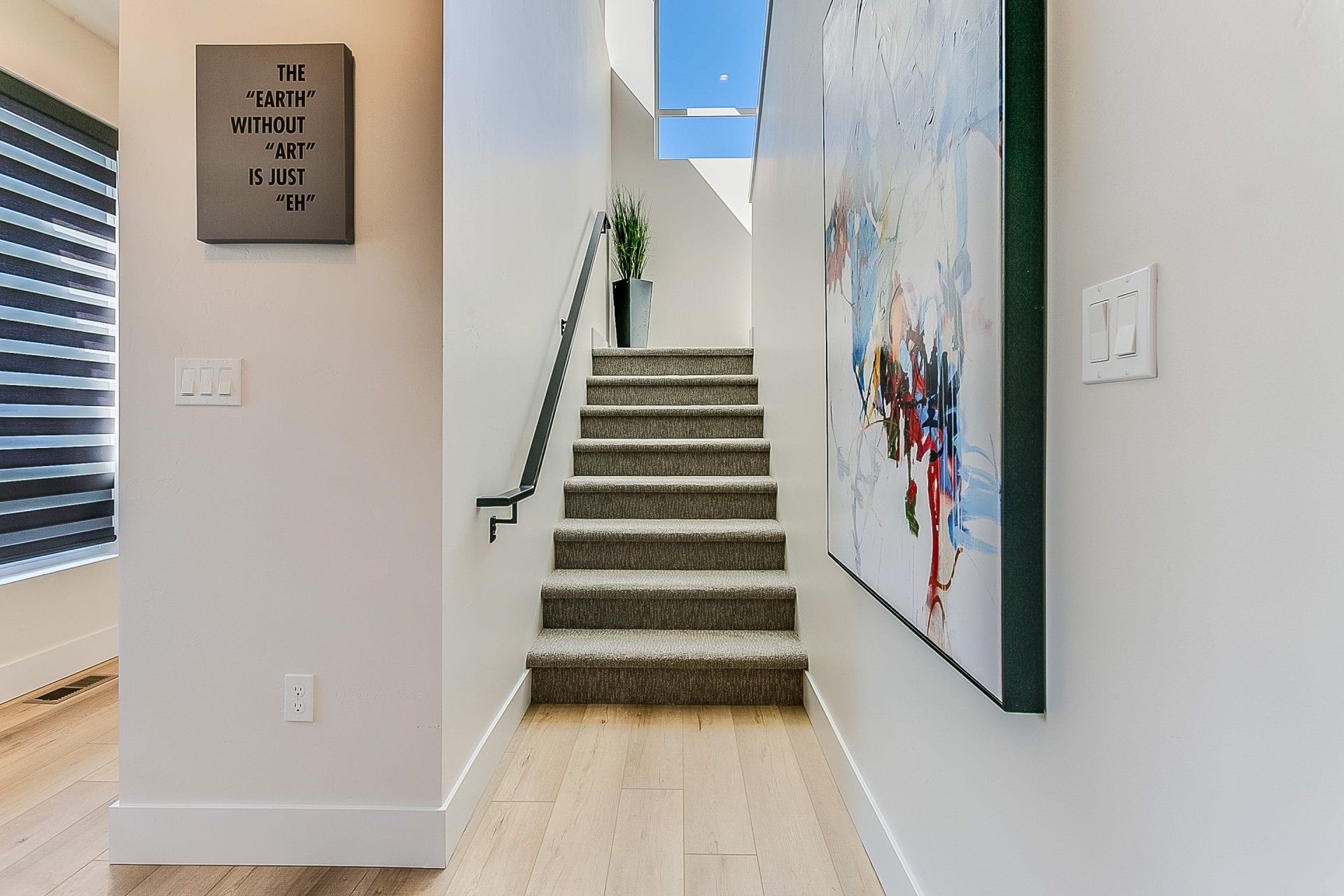
The eye deceives. Understanding lines has a major impact. A hallway is the easiest place in the house to hang art at a consistent centre-line height, run a picture rail, or commit to a single colour band along one wall. Industry guidance converges around hanging art with its centre at about 150cm above the floor, and the discipline of a single line down a corridor reads more confident than a scatter at varying heights. Where the runner stops matters too. Finish a runner cleanly at a doorway threshold rather than partway along a wall, and the eye reads the geometry as deliberate.
Colour itself matters too. A hallway with no natural light is one of the few rooms where a deeper, warmer tone often reads better than a paler one. Cold corridors painted optical white feel like service tunnels. The same corridor in a muted clay, a soft olive or a warm taupe, with the lighting and the joinery doing their work, reads intentional rather than dim.
The hallway test is simple. Stand in it with the lights on, no people walking through, and ask whether anything about it has been designed. If the answer is no, a weekend’s work, better lighting, joinery added, art rehung to a line, a runner chosen to the right length, turns a corridor into a room. The rest of the house feels bigger for it.